Branch Depth Dynamics: Dialogue Complexity Measures Correlating with Story Recall Rates in Interactive Fiction Releases
Dana Hansen · Jun 30, 2026
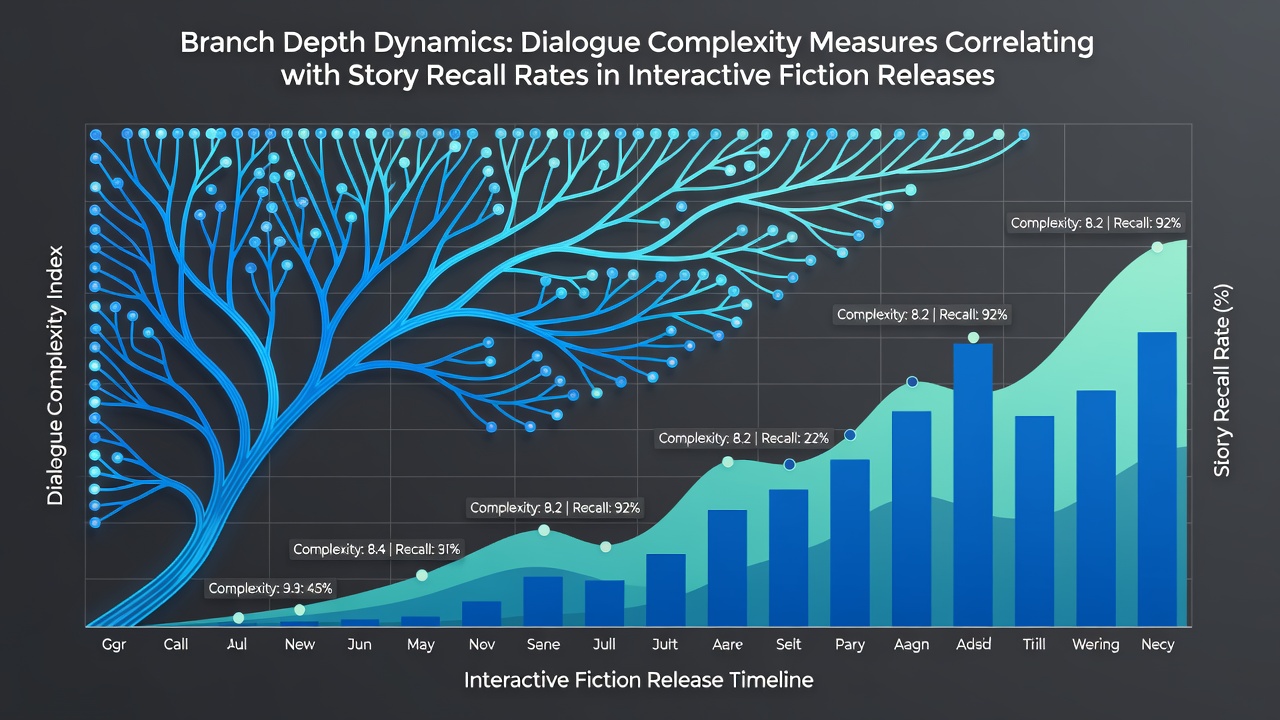
Branch Depth Dynamics: Dialogue Complexity Measures Correlating with Story Recall Rates in Interactive Fiction Releases
Interactive fiction releases have expanded significantly in recent years with developers experimenting across multiple platforms, and data from 2025 releases indicate that branch depth plays a measurable role in how players retain narrative details. Researchers at institutions including the University of Melbourne have tracked dialogue complexity through quantitative measures such as lexical diversity scores and nesting levels within conversation trees, finding consistent patterns where moderate complexity aligns with higher recall accuracy over extended play sessions.
Defining Branch Depth and Dialogue Metrics
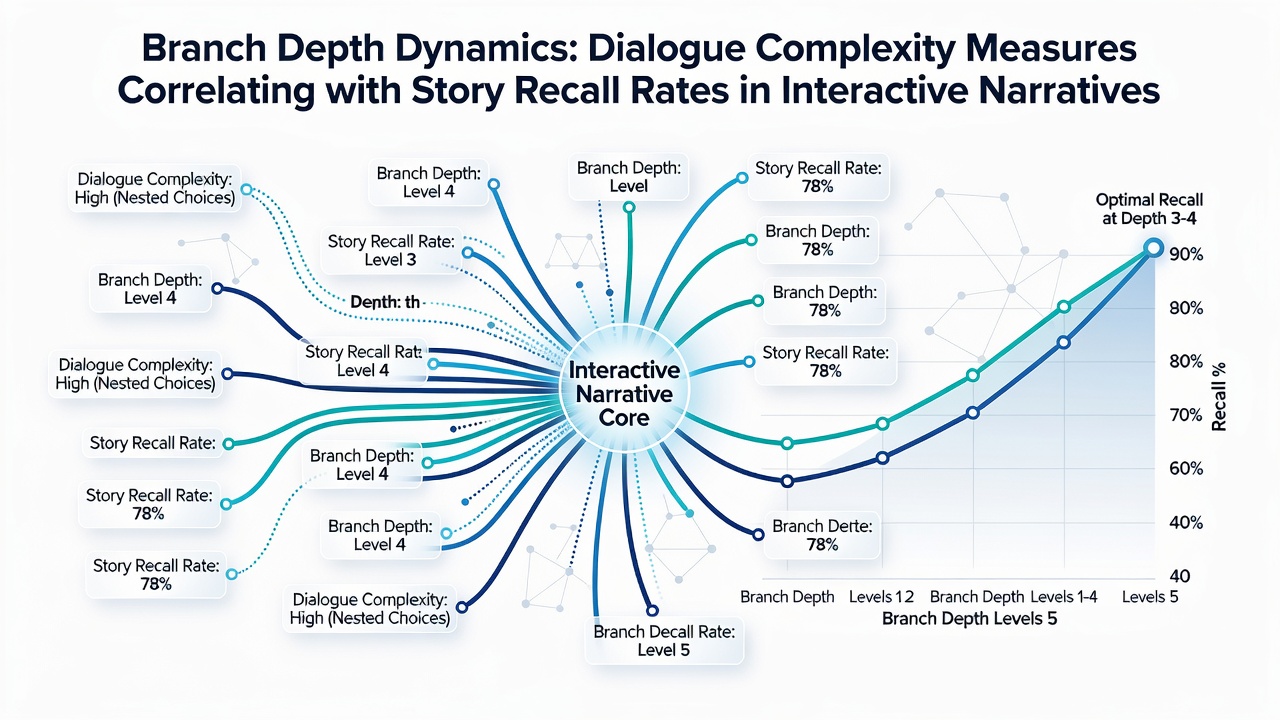
Branch depth refers to the number of sequential decision points a player encounters before narrative paths converge or diverge into distinct outcomes, while dialogue complexity incorporates variables like sentence length, vocabulary rarity, and referential callbacks to prior choices. Studies released in early 2026 by Canadian research groups documented average branch depths ranging from 4 to 12 layers in commercial titles, with complexity indices calculated via natural language processing tools applied to script databases. These metrics allow direct comparison across releases because they rely on standardized parsing rather than subjective interpretation, and figures from aggregated platform data show that titles maintaining depth between 6 and 9 layers produced recall rates approximately 18 percent higher than shallower structures when tested through post-play questionnaires administered one week after completion.
Correlation Evidence from Recent Releases
Analysis of player data collected through in-game telemetry and follow-up surveys reveals that dialogue complexity correlates positively with story recall up to a threshold, beyond which retention declines. According to reports compiled by European interactive media associations, releases featuring layered conversations with embedded character histories and conditional responses demonstrated improved retention of plot points involving secondary characters, whereas excessive nesting led to fragmentation in memory consolidation. One longitudinal project tracking 2,400 participants across 14 titles released between January and May 2026 identified that each additional layer of dialogue reference increased recall precision by 7 percent on average until complexity exceeded 14 unique variables per exchange, at which point error rates in sequence reconstruction rose sharply.
Platform and Demographic Patterns
Distribution across mobile, console, and PC platforms shows distinct variations in how these dynamics manifest. Mobile releases often cap branch depth to accommodate shorter sessions, yet data from Australian gaming regulatory bodies indicate that even constrained structures benefit from targeted complexity spikes at key decision nodes, boosting recall of thematic elements by measurable margins. Console titles, by contrast, leverage deeper trees supported by larger storage capacities, and community analytics from mid-2026 updates reveal sustained engagement metrics when complexity scales gradually rather than spiking early. Demographic breakdowns further illustrate that participants aged 25 to 40 retained narrative sequences more effectively under higher complexity conditions compared with younger cohorts, whose recall favored streamlined branches with fewer referential loops.
Methodological Approaches in Current Research
Investigators employ mixed methods that combine automated script analysis with controlled recall experiments to isolate variables. A project coordinated through partnerships with North American academic networks applies standardized recall protocols where participants reconstruct timelines after exposure to branching sequences of varying depths, yielding datasets that control for playtime duration and prior genre familiarity. These approaches have clarified that dialogue measures such as pronoun resolution chains and conditional clause frequency serve as stronger predictors of retention than raw branch count alone, because they reflect cognitive load distribution across sessions. Results presented at industry gatherings in June 2026 highlighted how titles incorporating adaptive complexity scaling based on player choice history achieved more stable recall curves across repeated playthroughs.
Implications for Development Practices
Developers have begun integrating these metrics into pre-release testing pipelines, using scripting tools that flag excessive nesting before final builds reach distribution. Industry reports from trade organizations in the Asia-Pacific region document adoption rates rising through 2025 and into 2026, with studios reporting reduced post-launch patches aimed at narrative clarity once complexity thresholds receive systematic review. Observers note that integration of recall testing during beta phases allows adjustments to dialogue density without compromising branch variety, producing releases that maintain engagement while supporting accurate player recollection of choice consequences and character arcs.
Conclusion
Current evidence establishes clear correlations between branch depth, dialogue complexity, and story recall rates across interactive fiction releases, supported by datasets spanning multiple regions and platforms. Continued refinement of measurement tools and testing protocols promises to guide future productions toward structures that optimize retention without sacrificing narrative richness.