Dialogue Tree Complexity Levels Tied to Decision Regret Patterns in Interactive Fiction Titles from Narrative-Focused Mobile Developers
David Schröder · Jun 25, 2026
Dialogue Tree Complexity Levels Tied to Decision Regret Patterns in Interactive Fiction Titles from Narrative-Focused Mobile Developers
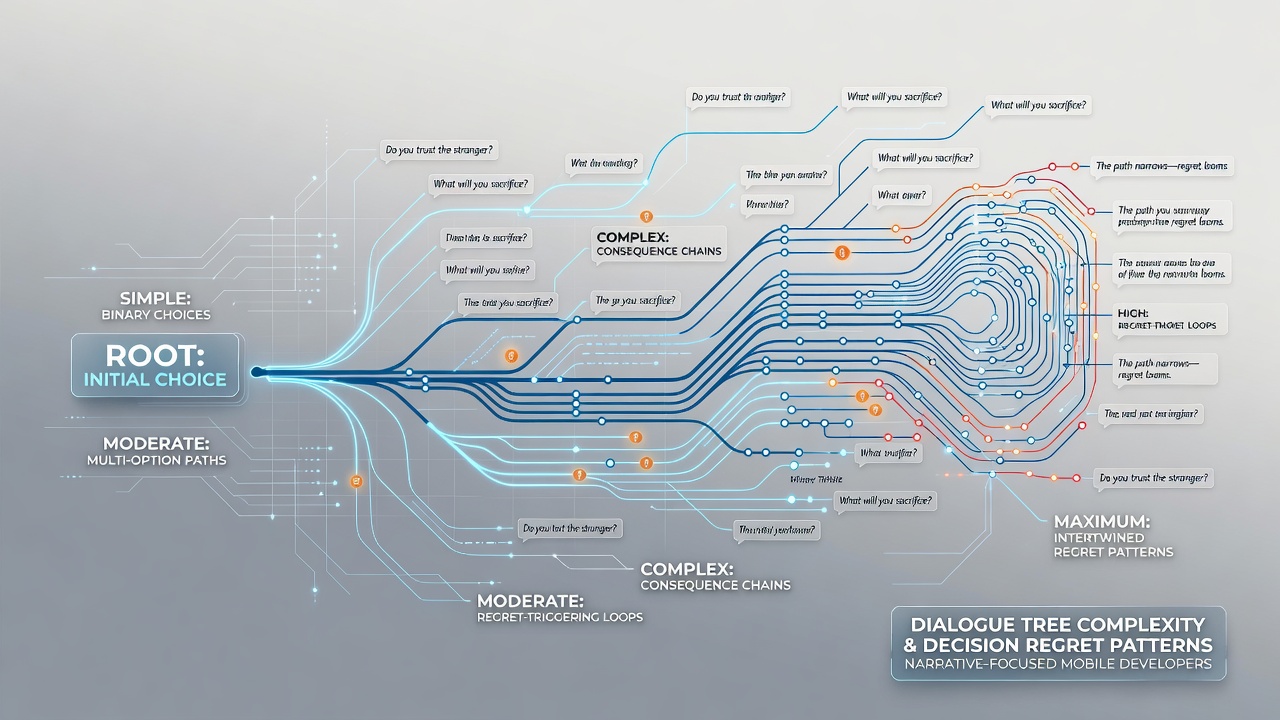
Narrative-focused mobile developers continue to refine dialogue tree structures as core mechanics in interactive fiction titles, where complexity directly influences how players process choice outcomes and subsequent regret. Studies track these patterns through aggregated player data from apps released between 2023 and 2026, revealing measurable correlations between branch depth and post-decision reflection rates. Developers adjust tree density to balance engagement against frustration, drawing on telemetry that logs selection frequency alongside completion metrics. Levels of dialogue tree complexity range from linear paths with minimal forks to intricate webs involving conditional branches, hidden variables, and time-sensitive triggers. Simple trees limit options to two or three choices per node, which research indicates produce lower regret scores because players encounter fewer alternative scenarios to compare against final results. Moderate complexity introduces four to six branches per decision point along with some state persistence across chapters, leading to elevated regret when players revisit earlier selections after unlocking new information. High-complexity systems incorporate procedural elements, character memory flags, and cross-chapter dependencies that expand possible outcome combinations into the hundreds, correlating with the highest recorded regret frequencies in mobile interactive fiction communities. Data from mobile titles developed by studios emphasizing narrative depth shows distinct regret patterns tied to these tiers. Players in moderate-complexity environments report regret spikes when a single choice blocks access to multiple later branches, prompting restart behaviors that increase session counts but reduce overall completion percentages. High-complexity trees amplify this effect because the volume of interconnected decisions makes full outcome mapping impractical without external guides or repeated playthroughs. Observers note that regret manifests most clearly in metrics such as chapter reload rates and forum discussions about missed paths, with patterns emerging consistently across genres like mystery adventures and relationship simulators. One case involves a mobile release from a European narrative studio where tree complexity was calibrated at the moderate level, resulting in decision regret concentrated around relationship choices that altered companion availability in later acts. Telemetry collected through June 2026 demonstrated that players who encountered irreversible outcomes revisited the same chapter 2.3 times on average, compared with 1.1 revisits in simpler tree designs from comparable titles. Another example from North American developers featured high-complexity systems with hidden alignment meters, where regret patterns shifted toward mid-game decisions that retroactively invalidated earlier alliances, producing measurable drops in daily active users after peak narrative tension points. Researchers examining these dynamics draw from multiple datasets, including reports issued by the Entertainment Software Association that document mobile narrative engagement trends across regions. Additional findings come from academic analyses at institutions such as the University of Melbourne, which examined how branch volume affects cognitive load and subsequent player reflection. These sources indicate that regret intensity scales with the number of visible alternatives at each node, yet plateaus once players exceed a threshold of roughly eight simultaneous options because information overload reduces comparative evaluation. Mobile developers respond to observed patterns by implementing adjustable tree parameters such as optional hint systems or post-decision summaries that mitigate regret without simplifying core structures. Titles incorporating these features show reduced chapter abandonment rates while preserving the depth that drives replay value in narrative-focused releases. Patterns also vary by platform display constraints, with smaller screens limiting simultaneous option visibility and thereby concentrating regret on choices made without full contextual awareness. Further examination of player behavior reveals that regret patterns evolve across multiple play sessions, with initial encounters producing higher emotional response scores that decline on subsequent runs as familiarity with tree logic increases. Developers monitor these shifts through version updates that tweak branch visibility or add new conditional paths, observing corresponding changes in regret-linked metrics like negative review volume and uninstall timing. Such adjustments maintain audience retention without altering fundamental narrative scope.Measuring Complexity Through Structural Analysis
Structural metrics provide quantitative frameworks for classifying dialogue trees in mobile interactive fiction. Node count, average branching factor, and dependency depth serve as primary indicators, with researchers mapping these elements against regret indicators derived from session logs and survey responses. Higher dependency depth, defined as the longest chain of conditional outcomes, associates strongly with sustained regret because players must track distant consequences across extended play periods.
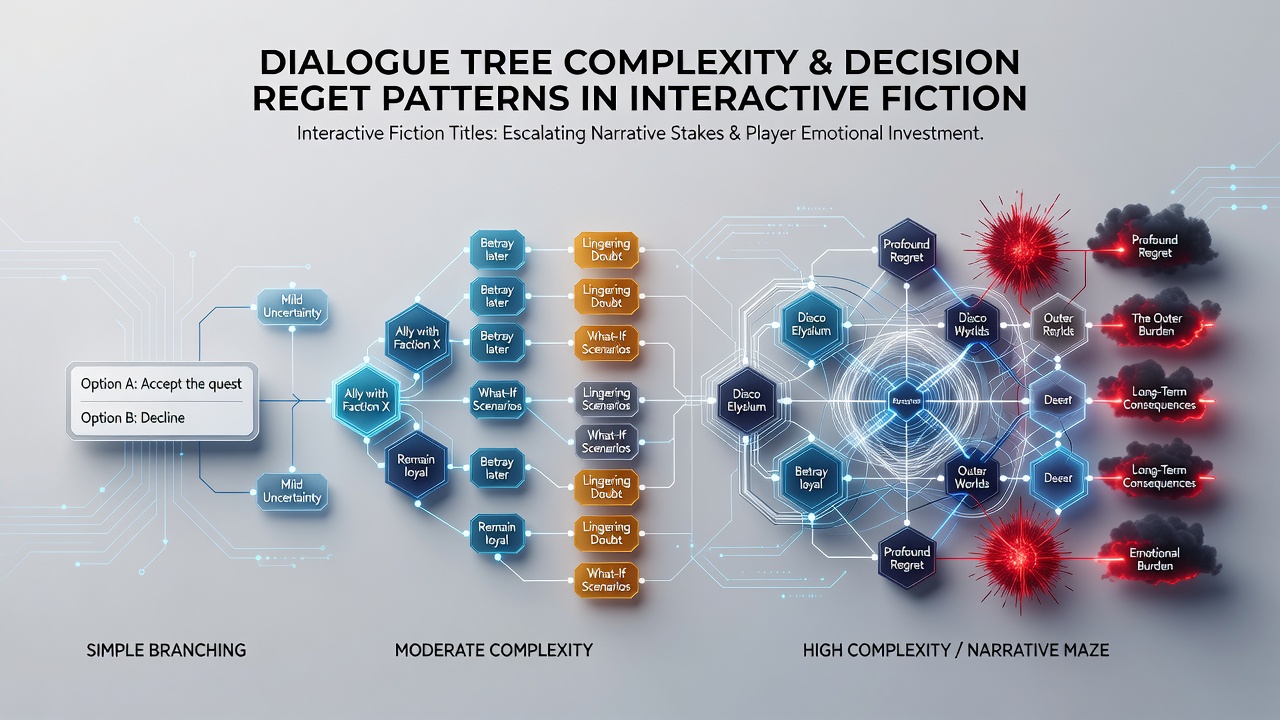
Analysis of titles released after 2024 demonstrates that trees exceeding 150 nodes with dependency chains longer than five steps generate the most pronounced regret clusters around pivotal narrative junctures. Developers apply these measurements during design phases to calibrate difficulty, ensuring complexity remains accessible while preserving meaningful choice weight. Data patterns indicate that incremental increases in branching factor beyond four options per node produce nonlinear rises in regret frequency until additional support mechanics intervene.
Regional Variations in Player Responses
Player responses to dialogue tree complexity show geographic differences influenced by cultural narrative expectations and device usage habits. Reports from the Japan Computer Entertainment Suppliers Association highlight that East Asian markets favor higher complexity levels paired with extensive hint integrations, resulting in regret patterns that resolve through community-shared solution databases rather than individual restarts. European markets display stronger correlations between moderate complexity and regret when character-driven decisions carry long-term social consequences, according to aggregated data from regional industry trackers.
These variations prompt developers to localize tree structures, adjusting option density and consequence visibility for specific audiences while preserving core narrative integrity. Such adaptations maintain consistent engagement metrics across global releases despite differing regret thresholds.
Conclusion
Dialogue tree complexity levels in narrative-focused mobile interactive fiction continue to shape decision regret patterns through direct influence on choice visibility, outcome dependency, and player reflection opportunities. Quantitative tracking from industry reports and academic sources establishes clear linkages between structural features and behavioral responses, guiding ongoing refinements by developers. These patterns inform design practices that balance narrative richness against player satisfaction across diverse markets and platforms.