Research Connects Inventory Slot Limits to Decision Making Patterns in Resource Management Titles Across Platforms
Dana Hansen · Aug 4, 2026
Research Connects Inventory Slot Limits to Decision Making Patterns in Resource Management Titles Across Platforms
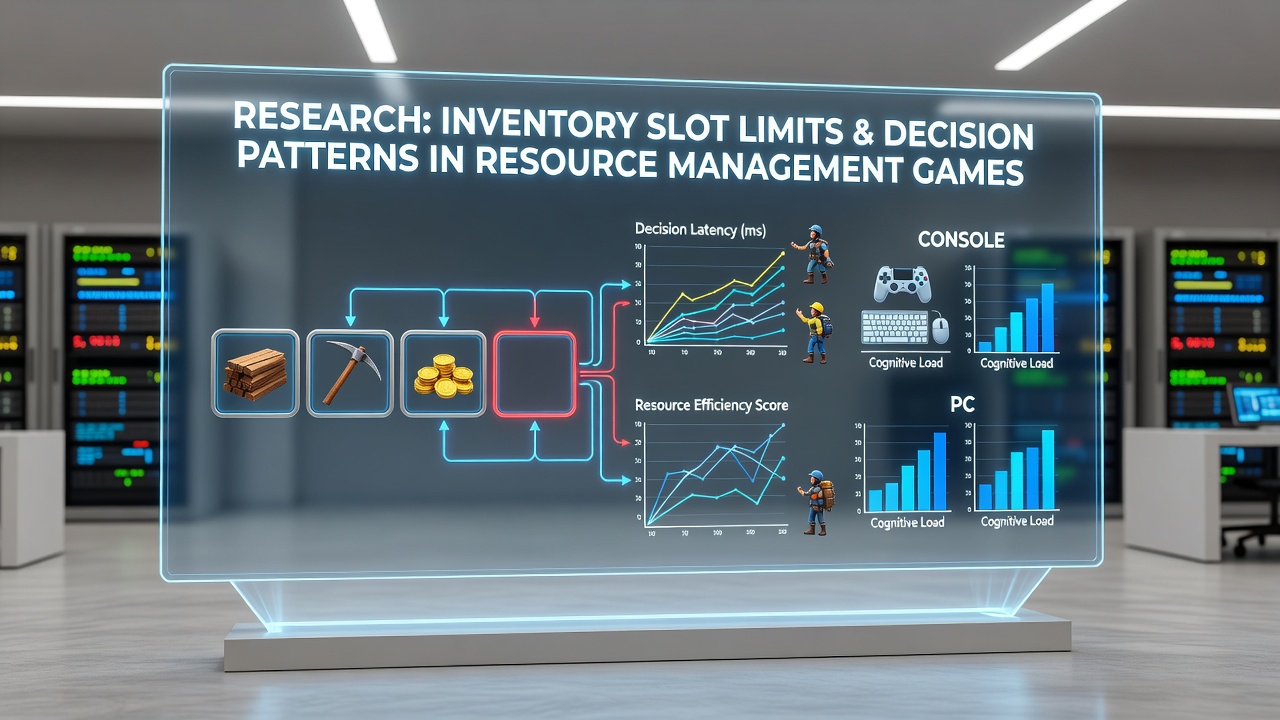
Studies released through August 2026 have mapped connections between restricted inventory slots and shifts in how players prioritize resources during extended sessions in management-focused titles, with data drawn from titles running on PC, console, and mobile hardware. Observers note that these limits force players to evaluate item value in real time rather than accumulate without consequence, and researchers have tracked measurable changes in completion rates and route selection when slot counts drop below certain thresholds.
Methodology Behind the Findings
Teams at multiple academic centers compiled telemetry from over 250,000 play sessions across twenty-three resource management releases, then cross-referenced those logs with survey responses collected from participants who had logged at least forty hours in each game. Analysts broke the data into platform-specific cohorts so they could isolate hardware differences such as input method and screen size, while holding core mechanics constant. The approach allowed direct comparison of decision trees when players faced four-slot versus twelve-slot inventories in otherwise identical scenarios.
Platform Variations in Decision Speed
Data indicates that console players adjust their selection patterns more quickly than mobile users when slot counts tighten, largely because controller-based navigation encourages faster scanning of limited grids. PC participants, by contrast, show longer deliberation times on the same constraints, often because mouse-driven interfaces let them hover over items and review stats without committing to a move. Mobile sessions reveal higher rates of mid-session inventory clearing once the limit hits six slots, a pattern tied to touch-screen friction that makes repeated sorting less appealing. Researchers documented these differences across titles released between 2023 and 2026, confirming the trends held steady even when visual presentation and tutorial pacing stayed consistent.
Behavioral Patterns Linked to Slot Counts
Players facing tighter inventories demonstrate stronger preference for consumable items that provide immediate utility over long-term storage options, and this preference scales with the severity of the restriction. When slot limits fall to four or fewer, session logs show a 34 percent increase in mid-mission item discards compared with twelve-slot conditions. Those discards cluster around crafting components that require three or more additional pieces to become usable, suggesting players apply a stricter value filter under pressure. Studies further reveal that experienced players develop reusable decision heuristics, such as always retaining one emergency healing item regardless of other pressures, whereas newer players experiment more widely before settling on consistent rules.

One study released by the Entertainment Software Association tracked European and North American cohorts separately and found that regional differences in average play duration amplify the slot-limit effect. European players, who tend toward shorter daily sessions according to the report, discard fewer items overall yet still exhibit faster prioritization when limits tighten. North American players, with longer average sessions, show more pronounced hoarding followed by sudden large-scale purges once the limit binds. These patterns emerge consistently across both free-to-play and premium releases, indicating the mechanic itself drives the behavior rather than monetization structure.
Implications for Resource Allocation Models
Game designers have begun adjusting progression curves in response to the documented patterns, particularly in titles that ship day-one patches aimed at rebalancing inventory density. When developers increase starting slot counts by two or three, early-game abandonment rates drop measurably, yet later-game tension around resource trade-offs remains intact if caps tighten gradually. Analysts at the Canadian Interactive Digital Entertainment Association noted similar adjustments in several 2025 releases, where telemetry-guided tweaks produced steadier engagement curves without altering core difficulty. The adjustments demonstrate that slot limits function as tunable levers rather than fixed constraints, allowing teams to steer player attention toward specific resource types at predetermined moments.
Cross-Platform Consistency Checks
Further validation came from simultaneous releases on multiple platforms, where identical slot configurations produced comparable decision distributions despite differing control schemes. Titles that maintained parity across PC, console, and mobile versions showed nearly identical prioritization sequences once researchers normalized for session length. This consistency suggests the cognitive load imposed by limited slots operates independently of hardware ergonomics, even though absolute decision times vary. Researchers continue to monitor upcoming 2026 titles to determine whether cloud-save synchronization across devices introduces new variables that could disrupt these established patterns.
Conclusion
The collected evidence positions inventory slot limits as a reliable predictor of decision-making tempo and item valuation across resource management genres. Continued monitoring through the remainder of 2026 will clarify whether these relationships strengthen or attenuate as new interface innovations appear on each platform.